Book Review: Let’s Take the Long Way Home by Gail Caldwell

Description from the publisher:

“It’s an old, old story: I had a friend and we shared everything, and then she died and so we shared that, too.”

So begins this gorgeous memoir by Pulitzer Prize winner Gail Caldwell, a testament to the power of friendship, a story of how an extraordinary bond between two women can illuminate the loneliest, funniest, hardest moments in life, including the final and ultimate challenge.

They met over their dogs. Both writers, Gail Caldwell and Caroline Knapp, author of Drinking: A Love Story, became best friends, talking about everything from their shared history of a struggle with alcohol, to their relationships with men and colleagues, to their love of books. They walked the woods of New England and rowed on the Charles River, and the miles they logged on land and water became a measure of the interior ground they covered. From disparate backgrounds but with striking emotional similarities, these two private, fiercely self-reliant women created an attachment more profound than either of them could ever have foreseen.

The friendship helped them define the ordinary moments of life as the ones worth cherishing. Then, several years into this remarkable connection, Knapp was diagnosed with terminal lung cancer.

With her signature exquisite prose, Caldwell mines the deepest levels of devotion and grief in this moving memoir about treasuring and losing a best friend. Let’s Take the Long Way Home is a celebration of life and of the transformations that come from intimate connection—and it affirms, once again, why Gail Caldwell is recognized as one of our bravest and most honest literary voices.

This book really got me.

It reminded me a lot of the film Once, which is centered on the idea that in life, it is extraordinarily rare to meet someone with whom we have a true, effortless connection. And that, for many people, it only happens once.

Much is said and written about romantic connections and familial connections, but less emphasis is placed on friendships, especially as we get older. This book serves as a touching tribute to the importance that friendship can have in a person’s life, and the overwhelming grief that occurs when it’s gone.

I picked this book up because I’ve recently experienced the ending of a close friendship that spanned close to two decades of my life. “Let’s take the long way” was something we used to say to each other when we walked around together, talking about everything and nothing. I hoped this book would offer some advice regarding how to gain closure, but instead I found myself caught up in the friendship of Gail and Caroline, and mourning their loss of their dogs and each other almost as much as I’ve mourned my own loss. Though I knew how the story would end, I wished so badly that there would somehow be a surprise ending where Caroline lived and their friendship could resume. And I came away with the realization that sometimes closure is something other than what we expect and hope for. I was reminded of one of my favorite Jeanette Winterson quotes:

“You’ll get over it…” It’s the cliches that cause the trouble. To lose someone you love is to alter your life for ever. You don’t get over it because ‘it” is the person you loved. The pain stops, there are new people, but the gap never closes. How could it? The particularness of someone who mattered enough to grieve over is not made anodyne by death. This hole in my heart is in the shape of you and no-one else can fit it. Why would I want them to?

I really loved this book, and recommend it to anyone who has ever lost anyone, whether it was to death or simply to the ebb and flow of life.
Book Review: The Arsonist by Sue Miller

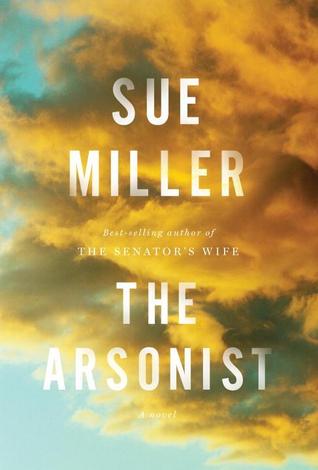
Description from the publisher: Troubled by the feeling that she belongs nowhere after working in East Africa for 15 years, Frankie Rowley has come home-home to the small New Hampshire town of Pomeroy and the farmhouse where her family has always summered. On her first night back, a house up the road burns to the ground. Is it an accident, or arson? Over the weeks that follow, as Frankie comes to recognize her father’s slow failing and her mother’s desperation, another house burns, and then another, always the homes of summer people. These frightening events, and the deep social fault lines that open in the town as a result, are observed and reported on by Bud Jacobs, a former political journalist, who has bought the local paper and moved to Pomeroy in an attempt to find a kind of home himself. As this compelling book unfolds, as Bud and Frankie begin an unexpected, passionate affair, arson upends a trusting small community where people have never before bothered to lock their doors; and Frankie and Bud bring wholly different perspectives to the questions of who truly owns the land, who belongs in the town, and how, or even whether, newcomers can make a real home there.

I really liked the first half of The Arsonist, but the second half sort of deflated and I found myself wishing I stopped reading it so I could have finished another library book that was due on the same day. The characters were interesting enough, but the story never really went anywhere. I think the author intended the fires and arsonist to be a metaphor or some type of symbolism, but I’m still not entirely sure for what. It’s almost as though Miller began writing based on a thoughtful concept and an interesting premise, but had no clue how to successfully execute them or how to conclude the story. Overall, it was a pretty disappointing read.

Book Review: All the Light We Cannot See by Anthony Doerr

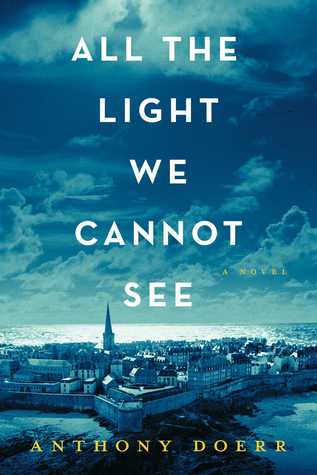
Description from the publisher: From the highly acclaimed, multiple award-winning Anthony Doerr, the beautiful, stunningly ambitious instant New York Times bestseller about a blind French girl and a German boy whose paths collide in occupied France as both try to survive the devastation of World War II.

Marie-Laure lives with her father in Paris near the Museum of Natural History, where he works as the master of its thousands of locks. When she is six, Marie-Laure goes blind and her father builds a perfect miniature of their neighborhood so she can memorize it by touch and navigate her way home. When she is twelve, the Nazis occupy Paris and father and daughter flee to the walled citadel of Saint-Malo, where Marie-Laure’s reclusive great-uncle lives in a tall house by the sea. With them they carry what might be the museum’s most valuable and dangerous jewel.

In a mining town in Germany, the orphan Werner grows up with his younger sister, enchanted by a crude radio they find. Werner becomes an expert at building and fixing these crucial new instruments, a talent that wins him a place at a brutal academy for Hitler Youth, then a special assignment to track the resistance. More and more aware of the human cost of his intelligence, Werner travels through the heart of the war and, finally, into Saint-Malo, where his story and Marie-Laure’s converge.

I cannot adequately describe how lovely and poignant this book is, so I will simply say that you should absolutely read it and be prepared to be moved to your very bones. Despite how sad it became at times, I wanted it to last and last, but couldn’t put it down, so as I neared the end, I found myself rereading passages to prolong my time with the interweaving stories. All the Light We Cannot See will undoubtedly be the most beautiful book I read this year.
Book Review: The Fever by Megan Abbott

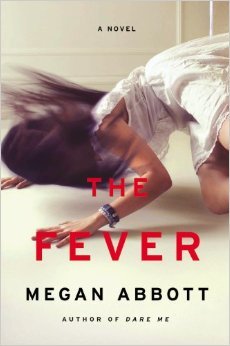
Description from the publisher: The panic unleashed by a mysterious contagion threatens the bonds of family and community in a seemingly idyllic suburban community.

The Nash family is close-knit. Tom is a popular teacher, father of two teens: Eli, a hockey star and girl magnet, and his sister Deenie, a diligent student. Their seeming stability, however, is thrown into chaos when Deenie’s best friend is struck by a terrifying, unexplained seizure in class. Rumors of a hazardous outbreak spread through the family, school and community.

As hysteria and contagion swell, a series of tightly held secrets emerges, threatening to unravel friendships, families and the town’s fragile idea of security.

Megan Abbott has very specific ideas about teenage girls. When boys run amok and engage in immoral activity, some simply say, ‘boys will be boys.’ In Abbott’s books, the boys are the voices of reason, and the girls are frenetic and misguided in their precociousness. Her characterization was effective in Dare Me, but less so in The FeverI think this is mainly due to a plot that misdirects in an attempt to achieve suspense, but feels flat in retrospect.

I think this is an okay book. It’s a quick read and kept me guessing. But when I’m through guessing and finally reach the answer, I want to wonder why I didn’t see it earlier. I finished this book and wondered about Megan Abbott’s contention with teenage girls.

October To-Do’s

I love October, but not because of pumpkin spice everything or the changing weather or the dozens of tiny pumpkins I bring home to decorate and bewilder my husband with (win-win!) I love October because I LOVE Halloween. As a life-long devotee of horror movies, creepy books, and the macabre in general, I try to dedicate my free time in October to scaring the crap out of myself. (Admittedly, not hard to do.) I’ve been planning for a while and am happy to finally bask in my to-do for October 2014:
To Read:
  •  Doctor Sleep by Stephen King. It’s the sequel to The Shining, which I read more than a decade ago and remains the scariest book I have ever read.
  • But I have heard that House of Leaves by Mark Danielewski might be the one to knock The Shining down a peg. My sister cannot talk about this book without noticeably shivering. I’m excited and terrified to read it.
  • We Have Always Lived in the Castle by Shirley Jackson. I heard of this book years ago, but didn’t realize it was by the same author of The Haunting of Hill House, which left a serious mark on my psyche and ability to sleep at night if I’m dumb enough to think of it before going to bed.
  • The internet provides so many scary stories for free, and it can be so easy to fall down the rabbit hole of scaring the bajesus out of yourself. My favorite sources are the subreddit, Let’s Not Meetthis fabulously creepy tumblr blog, and of course, Creepypasta.

To watch:

  • Every year I love to re-watch Bravo’s 100 Scariest Movie Moments and 13 Scarier Movie Moments. It’s a seriously great, definitive list with interesting discussion from writers, directors and actors who have passionately contributed to the genre, and is just wonderful to experience all over again each year. Unfortunately Bravo has stopped showing it, but fortunately both series are available in their entirety on YouTube.
  • I was disappointed by the last season of American Horror Story, but have high hopes for AHS: Freak Show, which premiers October 8.
    https://www.youtube.com/watch?v=eIhmgzmLEtY
  • Netflix is a veritable host of terrible horror movies, which can be so fun to watch. I’m hoping to get my Awesomely Bad Movie Club together for a viewing (and wish, not for the first time, that they would bring Basket Case back to the instant watch list.)
  • Every year I like to watch an old favorite, especially if it’s one my husband hasn’t seen. He recently revealed that he’s never watched Rosemary’s Baby, so introducing him to that mindfuck of a film has become a top priority.
  • And finally, I like to check out at least one or two new (to me) movies that horror fans rave about. This year my picks are The Changeling and Lake Mungo.

To listen to:

To visit:

  • I love to visit haunted places and go on haunted hayrides and take haunted house tours. This year I’m planning a day-trip to King’s Dominion for their Halloween Haunt with some friends. I went a few years ago and this doll factory scared the crap out of me:
    http://www.youtube.com/watch?v=39zpAyN1zJc

And with that, I should be sufficiently scared silly by Halloween.