January TBR

I decided to challenge myself to read 100 books in 2015, but try not to focus too much on it and just take it day by day. These are the books I’m planning to read in January:

Sense and Sensibility by Jane Austen
I’m sort of embarrassed to admit that despite being an English Lit major and a fan of hers, I’ve only read two Jane Austen novels. I watched The Jane Austen Book Club, and while it was pretty cheesy, I really liked the idea of reading books by a single author and discussing them with friends. I already started a book club late last year and put forth the idea. So we’ll see how that goes. But regardless, I’m excited to finally read all of her works, in order of publication. And I’m excited to watch movies based on the books I haven’t read, since I’ve been holding out on those as well.
bitch in a bonnet robert rodi book jane austen literary criticism analysis

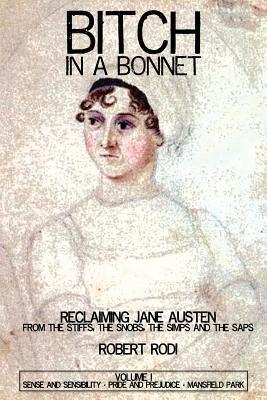
Bitch In a Bonnet: Reclaiming Jane Austen from the Stiffs, the Snobs, the Simps and the Saps (Volume 1) by Robert Rodi
I laughed out loud when I saw this title on Amazon and since it was only a couple dollars and had good reviews, decided to purchase it.

I really enjoy reading literary criticism and others’ perspectives on books, especially classic literature, which can be challenging. I figured this book (and other volumes in the series) would pair well with my deep dive into Jane Austen.

A Tale for the Time Being by Ruth OzekiA Tale for the Time Being by Ruth Ozeki
Here’s the publisher’s description: In Tokyo, sixteen-year-old Nao has decided there’s only one escape from her aching loneliness and her classmates’ bullying, but before she ends it all, Nao plans to document the life of her great-grandmother, a Buddhist nun who’s lived more than a century. A diary is Nao’s only solace—and will touch lives in a ways she can scarcely imagine. 

I added this book to my kindle and intended to read it in 2014. I opened it last week and before I knew it, had already blown through the first five chapters. A good sign.

Lila by Marilynne RobinsonLila by Marilynne Robinson
Here’s the description from the publisher: Lila, homeless and alone after years of roaming the countryside, steps inside a small-town Iowa church—the only available shelter from the rain—and ignites a romance and a debate that will reshape her life. She becomes the wife of a minister, John Ames, and begins a new existence while trying to make sense of the days of suffering that preceded her newfound security. Neglected as a toddler, Lila was rescued by Doll, a canny young drifter, and brought up by her in a hardscrabble childhood. Together they crafted a life on the run, living hand-to-mouth with nothing but their sisterly bond and a ragged blade to protect them. But despite bouts of petty violence and moments of desperation, their shared life is laced with moments of joy and love. When Lila arrives in Gilead, she struggles to harmonize the life of her makeshift family and their days of hardship with the gentle Christian worldview of her husband that paradoxically judges those she loves.

I’ve heard nothing but praise for this book, and I’ve been excited to read it for months. Which is how long it’s sat on my library holds list. But lo and behold, last week I found a copy available to check out and snatched it up. It’s been a long time since I’ve read Gilead, and I’m wondering if I should revisit it before reading Lila.

How to Tell Toledo from the Night Sky bbook How to tell toledo from the night sky by lydia netzery Lydia Netzer
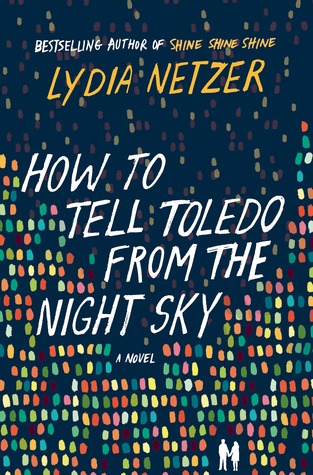
“Can true love exist if it’s been planned from birth?” Like a jewel shimmering in a Midwest skyline, the Toledo Institute of Astronomy is the nation’s premier center of astronomical discovery and a beacon of scientific learning for astronomers far and wide. Here, dreamy cosmologist George Dermont mines the stars to prove the existence of God. Here, Irene Sparks, an unsentimental scientist, creates black holes in captivity. George and Irene are on a collision course with love, destiny and fate. They have everything in common: both are ambitious, both passionate about science, both lonely and yearning for connection. The air seems to hum when they’re together. But George and Irene’s attraction was not written in the stars. In fact their mothers, friends since childhood, raised them separately to become each other’s soulmates. When that long-secret plan triggers unintended consequences, the two astronomers must discover the truth about their destinies, and unravel the mystery of what Toledo holds for them—together or, perhaps, apart.

I loved Shine, Shine, Shine, and I’m hoping I’ll love this book just as much.
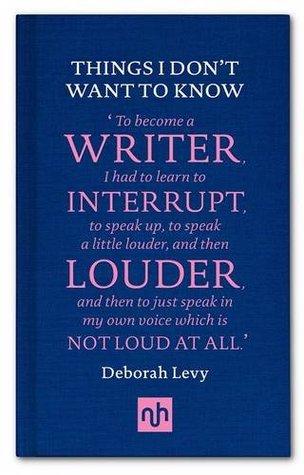
writing book things I don't want to know by deborah levy Things I Don’t Want to Know: On Writing by Deborah Levy
‘Perhaps when Orwell described sheer egoism as a necessary quality for a writer, he was not thinking about the sheer egoism of a female writer. Even the most arrogant female writer has to work over time to build an ego that is robust enough to get her through January, never mind all the way to December.’
Deborah Levy

One of my main goals for 2015 is to write every single day. Reviews of this book make it sound like an inspiring read, and I’ll take all the inspiration I can get.

10% Happier by Dan Harris book self-help meditation

10% Happier: How I Tamed the Voice in My Head, Reduced Stress Without Losing My Edge, and Found Self-Help That Actually Works–A True Story by Dan Harris
I joined Audible last month and I gotta say, selecting one book per month is really tough. I’m not always a big fan of self-help (even books that claim to not really be self-help) but this book had really good reviews so I decided to give it a whirl. I like the idea of meditation and finding ways to quiet my mind and stop worrying and thinking ahead. But I struggle with meditation and constantly find my mind wandering. I’m hoping this book has some good tips to avoid that.

Happy reading and Happy New Year!
Best of 2014

I read, watched, and listened to some pretty great things in 2014. These are my favorites:

Favorite Reads:

Fiction:
All the Light We Cannot See by Anthony Doerr
Landline by Rainbow Rowell

Memoir:
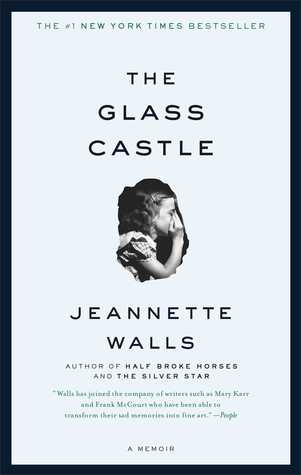
The Glass Castle by Jeannette Walls

Young Adult:
We Were Liars by E. Lockhart

Best Audiobook:
Yes Please by Amy Poehler

Best Short Stories:
Bark by Lorrie Moore and Stone Mattress by Margaret Atwood

Best Graphic Novel:
Sex Criminals by Matt Fraction & Chip Zdarsky
Your Illustrated Guide To Becoming One With The Universe By Yumi Sakugawa

Best Poetry Collection:
I Don’t Know Do You By Roberto Montes

I made a goal to read 75 books this year and surpassed it (by four books, but still; woot!) I’m debating whether I should challenge myself to at all in 2015. While making a specific goal and keeping track of whether I’m behind schedule definitely keeps me motivated, I do sort of agree with articles like this one, which argues that always keeping track of how many books you’ve already read is nerve wracking and is not really what reading should be about. I made a personal goal to post here four times a week, which seemed completely manageable for the first half of the year. There are so many great books I read this year that I keep meaning to write about here, but just haven’t found the time, and that’s a frustrating feeling.


Thanks to the success of Serial, many have dubbed 2014 “the year of the podcast.” Even Dear Sugar got in on the action! I’ve started listening to so many this year, some new, some just new to me. But I’ll try to keep this list reasonably short.

Favorite Podcasts:

Serial

This American Life

Gilmore Guys

The Scot and the Sassenach

Totally Laime (which is unfortunately ending soon)

BookRiot

Pop Culture Happy Hour

Not Too Deep with Grace Helbig

How Did This Get Made?

Dear Sugar Radio


I’m a huge fan of guilty pleasure television, especially when it comes to Reality TV. I know, I know, but I just can’t stop myself.

Favorite TV

Outlander

Orange is the New Black

Brooklyn Nine-Nine

The Affair

Hart of Dixie

How to Get Away With Murder

New Girl

Pretty Little Liars

The Chair

Real Housewives of Beverly Hills/Orange County

True Tori

Shark Tank


Finally, I watched some really fantastic films this year. These were my favorites:

Favorite Movies

Short Term 12

Chef

Snowpiercer

The Fault in our Stars

Veronica Mars

Mockingjay

Gone Girl

Divergent

Wild


You were a good year, 2014.

Happy New Year!

Book Review: The Glass Castle by Jeannette Walls

The Glass Castle

The Glass Castle is a remarkable memoir of resilience and redemption, and a revelatory look into a family at once deeply dysfunctional and uniquely vibrant. When sober, Jeannette’s brilliant and charismatic father captured his children’s imagination, teaching them physics, geology, and how to embrace life fearlessly. But when he drank, he was dishonest and destructive. Her mother was a free spirit who abhorred the idea of domesticity and didn’t want the responsibility of raising a family.

The Walls children learned to take care of themselves. They fed, clothed, and protected one another, and eventually found their way to New York. Their parents followed them, choosing to be homeless even as their children prospered.

A couple years ago, I was visiting a friend and she asked about my family. “I love to hear your stories,” she said, laughing, “because they make me feel so much better about my own life.”

I knew what she meant, but it still stung. I don’t think anyone wants to be that person, the one who others think about when they remind themselves that they don’t have it so bad. The one who makes others grateful for their own family, crazy as they might seem at times.

I didn’t pick up this book because I wanted to feel better about my own family, but rather because I thought I might have finally found someone to commiserate with. I’ve never known anyone with a crazier family than me. And I related to this book more than I expected to.

I had a fairly normal childhood. We had food, we lived in a house, we had toys and celebrated birthdays and Christmas. Money was tight, but my parents made it work. But their struggles with alcoholism and their volatile marriage worsened and eventually prompted a downward spiral that began when I was about twelve years old and continues to this day. We never wanted for basics, but they drank and fought and neglected to behave like other parents I knew (and more importantly, like the parents my siblings and I needed.)

I lost count years ago of how many times police were called in an effort to get them to quiet down. Or how many times we got between them when their fights became violent. Or how many times I lied about why we couldn’t hang out at my house, let’s just hang out at yours again.

I moved out of their house pretty much as soon as I became a legal adult and promised myself that I would never look back.

Except, well…I do look back. I sort of have no choice, as The Glass Castle elucidates. You think of your family and your experiences with them as normal, until you don’t. Your world expands and you get a pretty good idea of what “normal” actually is. And you’re eventually left feeling like there must be something wrong with you now that you know there was definitely something wrong with the people who raised you.

To say that the past decade has been hard for my parents would be a severe understatement. After inheriting half a million dollars upon her mother’s death, my mother proceeded to quit her job and run amok. If you tried to reason with her, she claimed that her mother never gave her anything and she married a man who denied her as well. That she spent her entire life feeling deprived, and this was her opportunity to finally have what she felt she deserved. She spent all of it and then some.

My father was laid off from his job as a mechanical engineer when I was a high school sophomore. He delivered newspapers and food and worked part time, but still couldn’t make ends meet. He spent his entire IRA on the mortgage and bills.

Their drinking got worse and their marriage deteriorated. Eventually, they had no choice but to sell their house. And then everything fell apart completely.

They lived with us off and on, usually until it got to be just too much and we needed a reprieve for our own sanity and the sake of our relationships. My mother spent the better part of the last year homeless. My father bounced around, renting rooms and losing jobs, until his precarious health landed him in the charity ward of a rehabilitation clinic after an infected blister caused him to lose one of his legs from the knee down, thanks to his untreated diabetes. He lived there for nearly a year, fighting with nurses and lying to doctors. My mother would visit him and sneak him drinks or check him out and they’d go straight to a bar or simply drink in their car. She slept there with him as often as she could, but was usually kicked out by the nursing staff. When that happened, she’d sleep in her car.

I finally cut off communication with both of them and haven’t spoken to either of them in months. Last I heard from my brother, they’re living in Pennsylvania.

I hope they’re happy. And then I realize how unrealistic that is, and hope that they’re finally getting it together. And then I settle for hoping that they’re still alive and somewhere warm.

Parts of The Glass Castle made me laugh. Parts made me so angry I wanted to hit something. By the end, I felt very sad. Sad for Jeannette and her siblings. Sad for me and mine. Sad for her parents, sad for my parents. Sad for anyone else who had a similar experience.

But I also felt nostalgic. I think that surprised me more than anything.

When I was a teenager, my brother and sister and I each had a few friends who knew what life in my parents house was really like. Sometimes I would smile and say, “they put the ‘fun’ in ‘dysfunction’!” Sometimes we would insist on having friends over and warn our parents for days in advance that they needed to let us have one night of peace. Most of the time, they complied.  They would still drink, of course, but wouldn’t scream at each other, and were almost silly. They would ask our friends questions, and tease us, and trade witty barbs with each other. I would lean against the kitchen counter, listening to them and marveling at my friends’ laughter, and admit that they could be pretty entertaining when they wanted to be.

To this day, if someone asks about my parents, what they’re like, what they do, I will say “My mother is very type-A and loves to garden and take photos. She always wanted to open an Irish step dancing school.  My dad is the smartest guy I’ve ever known. He obsessively watches Jeopardy and even tried out for it when I was a kid. He could tell you the history of the Beatles or either World War without so much as glancing at a book. He writes screenplays and has been working on one for a while, and it’s actually really good.”

Perhaps some could see this as lying or skewing the truth. But it’s part of the truth. It’s part of them. And it’s the part I want others to see sometimes because it’s so well-hidden that my parents sometimes forget about it themselves.

I read an article in Psychology Today over the weekend about the concept of a “true self.” The problem, the article posits, is that too many people feel stuck or backed into a corner because they are trying to live up to their “true self,” as though there is only one possibility for each of us. Would my true self wear this?, we ask while shopping. Does my true self want to live in the city or the suburbs? Would my true self like this genre? Watch this movie? Drink this wine?

We are comprised of so many different parts. Attributes and faults. Experiences and ambitions. My father’s sister abandoned her two children and left them to be raised by her mother. By anyone’s definition, she was not a good mother, or really even a mother at all for all intents and purposes. But if you ask her about her kids, you would think she was the greatest mother who ever lived. I asked my dad about it once, pointing out that it was pretty shitty of her to fail to acknowledge the truth. He told me that if she admitted it to anyone, she would have to admit it to herself. And if she did that, she’d probably kill herself.

We are also comprised of the lies we tell ourselves so that we don’t have to live with the true self that our actions have reduced us to.

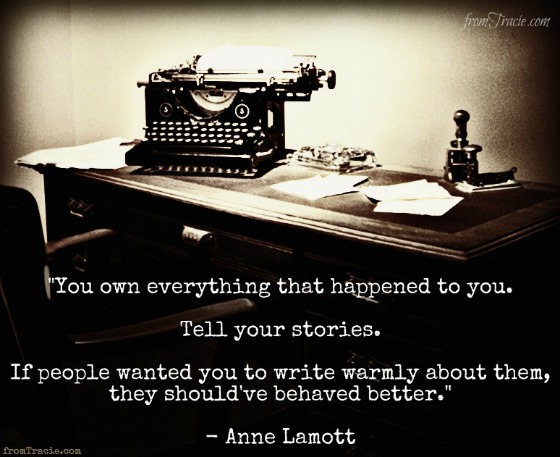
I think The Glass Castle imparts a valuable lesson about this. Jeannette Walls told her story the way Anne Lamott advises us to:

She reveals her childhood and the impact that it has on her adult life in a way that suggests she has no singular conclusion about her parents. It was crazy and scary and unconventional and infuriating and sad and an adventure. She begins the book by telling her mother (and us) that she is ashamed of the truth about her parents, that they are a secret she keeps well hidden. But as her story is unraveled, Jeannette is sometimes amused, sometimes defensive, sometimes horrified, and sometimes doesn’t seem to know how to feel about certain things.

I’ve read numerous reviews that comment on her parents and how disgusting it is that people “like that” are allowed to have children. I’ve read reviews where the reader just can’t believe that anyone could live the way they did. I’m sure these reviewers don’t intend for their words to be demeaning, just as my friend who asked for yet another crazy story about my crazy parents so that she could feel better about herself probably didn’t intend for her words to hurt my feelings. But really, it’s more complicated than just “good” or “bad,” and “crazy” or “sane.’ We are a lot more complicated than being defined or defining others as one true selves.

Life with my parents was crazy at times, and I wouldn’t wish the worst of it on anyone. But I will also readily admit that they weren’t all bad. And that having them as parents probably made me a much stronger and more independent and more compassionate person than I would have been otherwise. I’ve learned lessons from their mistakes and feel pretty confident that I will do things differently. I appreciate the everyday boringness that comprises my current life more than anyone else I know. Sometimes I all-out revel in it.

The Glass Castle gave me the gift of looking at the whole picture of my own family and realizing that there is no one true conclusion. I spent the second half of the story rooting for Jeannette and her siblings to escape so that they could build a life of their own away from the destructiveness of their parents. Just as I continue to root for myself and my siblings to cultivate our own lives away from our parents.

But I also found myself rooting for her parents to the very last page, as I’m sure I always will for my own. I wistfully remembered the good times with my family. All of the promises and plans, some kept, but most forgotten over time.

“We had some times, didn’t we?”
“We did.”
“Never did build that Glass Castle.”
“No. But we had fun planning it.”

Lucky are those who dream of glass castles. And lucky are those who are born in them. And lucky are those who have one built around them as they grow. But still lucky are those who grow up and build one for themselves.

Book Review: Friendship by Emily Gould

Friendship Emily Gould Book Review

First, a confession: I didn’t finish this book.

And not even because it was due back to the library before I could. I got about halfway through and found myself wistfully eyeing the stack of library books that were due at the same time. I’m not usually one for not finishing a book, but I finally reached the point where I was all, life is too short to spend time on something you’re meh about. 

I decided to put it down and come back to it if I felt the urge. It hasn’t moved from the table by my front door, and now serves as a reminder to return it. I didn’t hate it. It just didn’t hold my interest.

Which was unexpected. After reading the plot description, I felt pretty sure that I would find something to relate to in this book. Bev and Amy are approaching 30 and living in New York City. Bev is doing administrative temp work and Amy is a blogger. Both are struggling with their friendship, relationships, money, and adulthood in general.

I’m almost 30! I work as an admin! (Though not as a temp.) I am a blogger! I’ve struggled with close friendships!

So really, I expected to gobble this up.

I think the problem I had with the book was that their struggles, while realistic and common for millennials, just didn’t ring very true. There were too many coincidences and too many cliched characters. It reminded me a lot of HBO’s Girls, where true-to-life problems are diminished for the sake of a more interesting plot line. It felt almost satirical at times, and I really, really don’t think it was supposed to.

This book is Emily Gould writing about Emily Gould, which is plain as day to anyone who is familiar with her stint at Gawker and/or her blog. And really, that’s her prerogative. One of the first pieces of advice given to a writer is to “write what you know.” I guess I was just hoping for something a little more relatable.

To Be Read: The Library Books Edition

I read a BookRiot article yesterday on having too many things to read and how it can feel problematic, and even stressful. “The problems isn’t that I haven’t had time to read or that I’ve let myself get wrapped up in other hobbies, work, distractions, etc. The issue is that I have so many quality choices and so much access to books that I’m paralyzed, unable to zero in on one (or even two or three) to pursue with everything I’ve got.”

I understand that so well.

I’ve written before about how I choose what to read next, and how sometimes it can be difficult to forcibly extract yourself from a story that you really connected to. BookTuber Christine did a pretty hilarious and spot on video of that very feeling:

And while a mourning period can stop your reading momentum in its tracks, having so many great options can also leave you a little frustrated and paralyzed with indecision.

Who knew the act of reading could be so complicated?

I have what I frequently refer to as a “lifelong TBR” collection when someone asks “why do you have so many books??” There are books that I have owned for years and will continue to own and will not read this year or next year or maybe not even the one after that. And that’s fine.

But lately I’ve been feeling a little stressed by library books. To borrow from Blow, my ambition far exceeds my talent. Again and again. And again.

I have 18 books checked out right now. And while I know it’s unlikely that I will read all of them, here is a compilation of the books I’m most excited to read.


If Elizabeth Bennet had the washing of her own petticoats, Sarah often thought, she’d most likely be a sight more careful with them.

When I read the description of this book, I had a hard time believing that I’d never heard of it before. I’m guilty of having read fan novels extending and retelling Pride and PrejudiceLongbourn has been described as P&P meets Downton Abbey, as it’s the story of P&P told from the servants perspective. It has mixed reviews, but I’m excited to see if I like it.


It seems you either love or hate Emily Gould. I’ve read her blog and internet writing, knew that she was an editor for Gawker, and that she’s from Silver Spring, Maryland, which is in my neck of the woods. I was curious about her, and even more so when I read her account of writing a novel. So when I saw this book at Barnes and Noble, I decided that I didn’t want to buy it but I did want to read it and it sat on my library holds list for the last six months.

Described by the publisher as “a novel about two friends learning the difference between getting older and growing up,” I figure if anything, Friendship should offer something to relate to.


Since I’m always a sucker for a love story, always a sucker for a story that takes place in Paris, and always a sucker for historical fiction about writers or artists whose work I admire, I Always Loved You seems like it will be right up my alley.

The young Mary Cassatt never thought moving to Paris after the Civil War to be an artist was going to be easy, but when, after a decade of work, her submission to the Paris Salon is rejected, Mary’s fierce determination wavers. Her father is begging her to return to Philadelphia to find a husband before it is too late, her sister Lydia is falling mysteriously ill, and worse, Mary is beginning to doubt herself. Then one evening a friend introduces her to Edgar Degas and her life changes forever. Years later she will learn that he had begged for the introduction, but in that moment their meeting seems a miracle. So begins the defining period of her life and the most tempestuous of relationships.


I saw Colorless Tsukuru Tazaki and His Years of Pilgrimageon the new releases shelf, and did a double take, sure that it was mistakenly placed there, as it’s a fairly new and popular release, and surely must have holds stretching for months.
And then I more or less did the Grinch grin and added it to the stack I was holding.

Tsukuru Tazaki had four best friends at school. One day Tsukuru Tazaki’s friends announced that they didn’t want to see him, or talk to him, ever again. Since that day Tsukuru has been floating through life, unable to form intimate connections with anyone. But then he meets Sara, who tells him that the time has come to find out what happened all those years ago.

I loved Norwegian Wood and The Wind Up Bird Chronicles, and am slowly making my way through all of Murakami’s novels. I’m so excited to read this one.


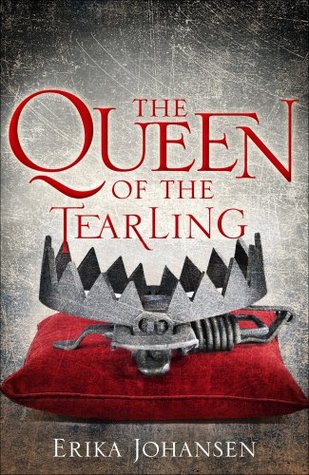
My interest was piqued when I read reviews comparing The Queen of the Tearling to The Hunger Games (strong female character, dystopian world) and Game of Thrones (medieval setting). But then I read reviews that say that’s not an apt comparison, and actually does the novel a disservice because those who read it because of that comparison wind up not liking it.

In the end, I was sold on this description: Combining thrilling adventure and action, dark magic, mystery and romance, The Queen of the Tearling is the debut of a born storyteller blessed with a startling imagination. 


Short stories by Margaret Atwood? ‘Nuff said.

(But I’ll be nice and paste the description if you need a bit more.)

A recently widowed fantasy writer is guided through a stormy winter evening by the voice of her late husband in “Alphinland,” the first of three loosely linked stories about the romantic geometries of a group of writers and artists. In “The Freeze-Dried Bridegroom,” a man who bids on an auctioned storage space has a surprise. In “Lusus Naturae,” a woman born with a genetic abnormality is mistaken for a vampire. In “Torching the Dusties,” an elderly lady with Charles Bonnet syndrome comes to terms with the little people she keeps seeing, while a newly formed populist group gathers to burn down her retirement residence. And in “Stone Mattress,” a long-ago crime is avenged in the Arctic via a 1.9 billion-year-old stromatolite. In Stone Mattress: Nine Tales, Margaret Atwood is at the top of her darkly humorous and seriously playful game.

I heard about In the Kingdom of Ice on NPRand thought it sounded like such a gripping read.

In the late nineteenth century, people were obsessed by one of the last unmapped areas of the globe: the North Pole. No one knew what existed beyond the fortress of ice rimming the northern oceans, although theories abounded. National glory would fall to whoever could plant his flag upon its shores.

James Gordon Bennett, the eccentric and stupendously wealthy owner of The New York Herald, funded an official U.S. naval expedition to reach the Pole, choosing as its captain George Washington De Long, who had gained fame for a rescue operation off the coast of Greenland. De Long led a team of 32 men deep into uncharted Arctic waters, carrying the aspirations of a young country burning to become a world power. On July 8, 1879, the USS Jeannette set sail from San Francisco to cheering crowds in the grip of “Arctic Fever.”

The ship sailed into uncharted seas, but soon was trapped in pack ice. Two years into the harrowing voyage, the hull was breached. Amid the rush of water and the shrieks of breaking wooden boards, the crew abandoned the ship. Less than an hour later, the Jeannette sank to the bottom,and the men found themselves marooned a thousand miles north of Siberia with only the barest supplies. Thus began their long march across the endless ice—a frozen hell in the most lonesome corner of the world. Facing everything from snow blindness and polar bears to ferocious storms and frosty labyrinths, the expedition battled madness and starvation as they desperately strove for survival.


May I read all of these before they are due!